
Mātanga Jātaka
Mātanga Jātaka
In the ancient city of Varanasi, nestled beside the sacred River Ganges, there lived a man of humble beginnings named Mātanga. Though his lineage was not of noble birth, his heart was filled with an unshakeable desire to attain spiritual enlightenment. He dedicated his life to ascetic practices, dwelling in a simple hermitage on the outskirts of the city, performing arduous penances under the scorching sun and the chilling moon. His fame for piety and self-discipline spread far and wide, reaching the ears of the King of Varanasi, who was a just and virtuous ruler.
One day, a particularly devastating famine struck the land. The crops withered, the wells ran dry, and the people suffered immensely. The King, deeply distressed by the plight of his subjects, consulted his wise ministers. They suggested performing a great sacrifice to appease the heavens and bring forth rain. However, the King, being a man of great compassion, was hesitant to perform any ritual that might cause harm or distress, even to the smallest creature. He pondered deeply, seeking a solution that would bring relief without causing suffering.
Meanwhile, Mātanga, through his intense meditative practices, gained profound insight. He foresaw that the famine was a consequence of past deeds, and that only a selfless act of great merit could avert the impending doom. He also perceived that the King, though noble, was blinded by pride in his own righteousness, which prevented him from fully understanding the nature of true compassion. Mātanga decided to test the King’s resolve and the depth of his virtue.
He transformed himself into a humble Brahmana, a scholar of sacred texts, and presented himself at the royal court. The King, recognizing the aura of wisdom and austerity about the man, welcomed him with great respect. Mātanga, speaking in a calm and measured tone, proposed a unique solution to the famine. He suggested that the King should perform a great act of charity, not by sacrificing animals, but by giving away all his accumulated wealth and possessions, and then begging for alms with his queen and retinue.
The King was taken aback. He had never heard of such a radical approach. "My good Brahmana," he said, his brow furrowed, "how can abandoning all I possess possibly bring an end to this drought? Surely, a grand ritual with offerings is the proper way."
Mātanga replied, "Your Majesty, true merit lies not in the outward show of sacrifice, but in the inward renunciation of attachment. The greatest wealth is not gold and jewels, but a heart free from greed and desire. If you can truly relinquish all that you hold dear, even your royal status, and humble yourself to beg for sustenance, your act of supreme selflessness will surely move the heavens."
The King, though skeptical, was intrigued by the Brahmana’s conviction. He considered the words, and the dire situation of his people weighed heavily on his mind. He decided to put Mātanga’s advice to the test. He announced his intention to his court, and to the astonishment of his ministers, he began to distribute his wealth amongst the needy. He gave away his palaces, his chariots, his jewels, and even his royal garments. His queen and his courtiers, inspired by his example or perhaps fearing his wrath, followed suit, though with varying degrees of willingness.
Then, clad in simple rags, the King and his queen, accompanied by a few loyal followers, went out into the city streets to beg for food. The people, who had always seen their King in splendor, were stunned. Some wept, some offered what little they had, and some looked on in disbelief.
Mātanga, still in his Brahmana guise, observed the King’s actions with keen interest. He saw the King’s genuine struggle, the humility in his eyes as he accepted meager offerings, and the growing realization of his own ego’s grip. As the King begged, Mātanga approached him, carrying a simple bowl of rice.
"Your Majesty," Mātanga said gently, "you have shown remarkable courage and renunciation. Your act of humility has touched the hearts of many." He offered the bowl of rice to the King. The King, with trembling hands, accepted the offering, a tear rolling down his cheek. In that moment, he understood the profound lesson.
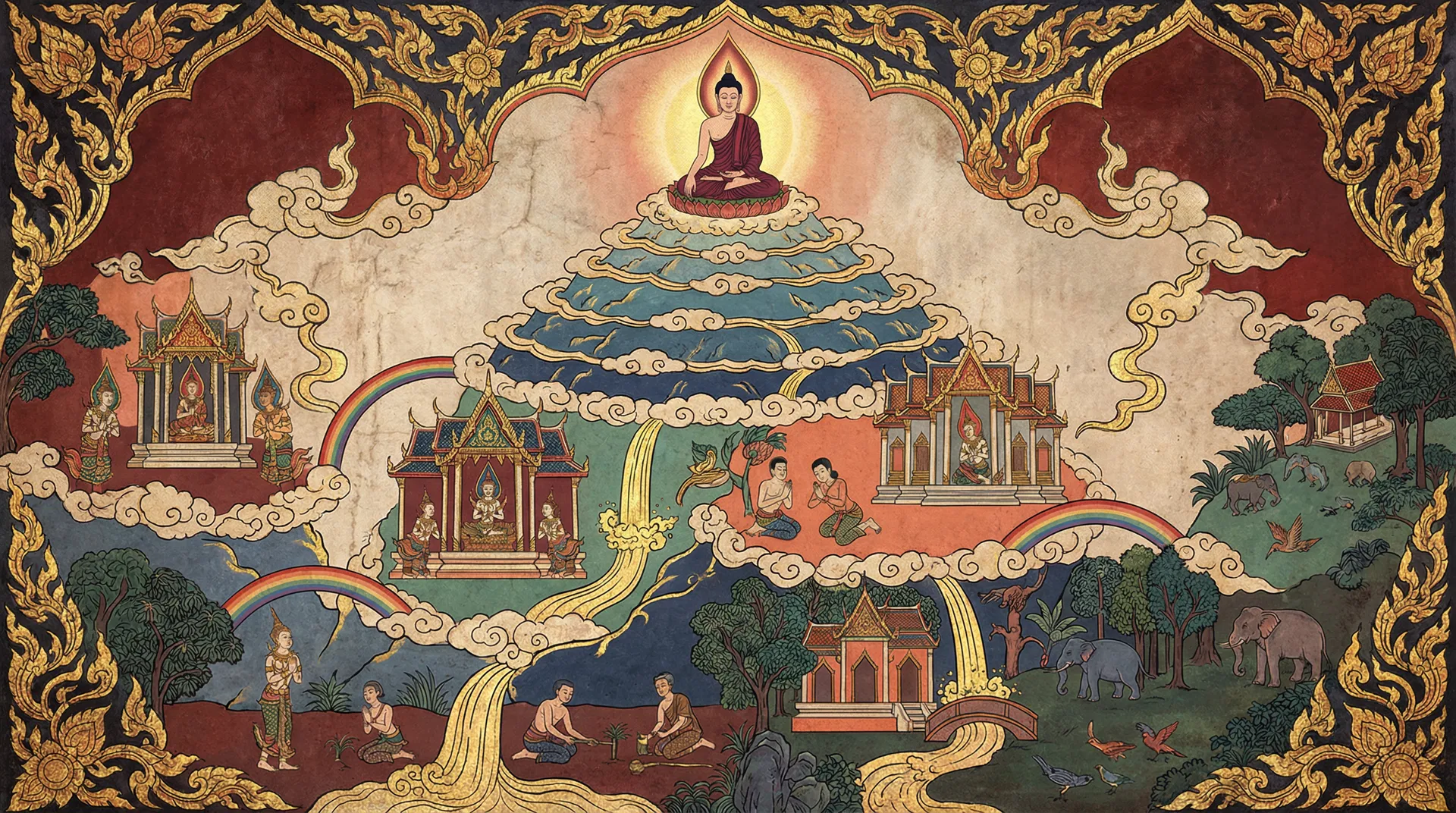
As the King accepted the rice, a rumbling sound was heard in the distance. Dark clouds began to gather in the sky. A gentle breeze stirred, carrying the scent of rain. Soon, the heavens opened, and a torrential downpour began to quench the parched earth. The famine was over. The people rejoiced, praising the King's wisdom and the Brahmana's guidance.
The King, having experienced true humility and the emptiness of material possessions, sought out Mātanga to express his gratitude. When he found the Brahmana, Mātanga revealed his true form. The King was awestruck to realize he had been guided by a Bodhisattva. Mātanga explained that true charity is not the giving of wealth, but the giving of oneself – one's ego, one's pride, one's attachments. By emptying himself, the King had made space for compassion and understanding to flourish, thereby aligning himself with the cosmic forces that bring abundance.
The King, transformed by his experience, ruled his kingdom with newfound wisdom and compassion, always remembering the lesson of true renunciation and the emptiness of worldly possessions.
— In-Article Ad —
💡Moral of the Story
True renunciation and humility are more powerful than any material offering or ritual in overcoming adversity and bringing about true prosperity.
Perfection: Generosity (Dāna) and Renunciation (Nekkhamma)
— Ad Space (728x90) —
More Jataka Tales You May Enjoy
 82Ekanipāta
Kaccāpabha Jātaka
Kaccāpabha Jātaka In the ancient land of Kāsi, nestled beside a mighty river, lay a prosperous city ...
💡 Do not let unfounded fears or superstitions dictate your actions. Seek to understand the true nature of things through reason and observation.
 493Pakiṇṇakanipāta
The Wisdom of the Humble Bee
The Wisdom of the Humble Bee In a sun-drenched meadow, where wildflowers danced in the breeze and th...
💡 True strength lies not only in power and aggression, but in wisdom, observation, careful planning, and collective unity. Even the smallest among us can possess great insight.
 197Dukanipāta
Kaccāpāna Jātaka
The Tale of the Wise TortoiseIn a verdant forest beside a clear, flowing river, lived a community of...
💡 True leadership is built on wisdom, justice, and compassion for all subjects, not on fear or brute force. Cooperation and foresight are more valuable than empty promises.
232DukanipātaPhra Ong Khong Khon (The Bodhisatta as a King Who Values Honesty)
Phra Ong Khong Khon (The Bodhisatta as a King Who Values Honesty) In the bustling city of Varanasi, ...
💡 Honesty is the most valuable treasure, far surpassing any material wealth. True worth lies in integrity and truthfulness, which form the bedrock of a just and prosperous society.
214DukanipātaSamukkita Jataka
The Value of Truthful SpeechIn the ancient city of Ujjain, there lived a renowned scholar named Vidh...
💡 Truthful and honest communication is the most effective means of resolving conflict and building lasting peace and prosperity, far more valuable than deception or force.
154DukanipātaMātanga Jātaka
Mātanga JātakaIn the ancient city of Mithila, there lived a young woman of unparalleled beauty and g...
💡 True wisdom is accompanied by humility and compassion; superficial knowledge, when fueled by ego, leads to arrogance.
— Multiplex Ad —